All guides Plate I Advanced

Veiled chameleon

Chamaeleo calyptratus

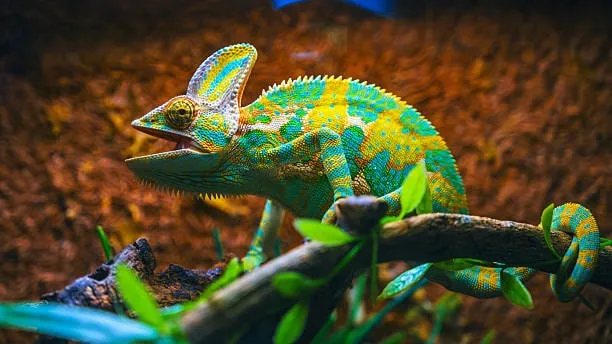
With independently moving eyes, a tongue longer than its body and the build of a dinosaur, they look like they stepped out of a science-fiction film. Although not an animal recommended for beginners, the veiled chameleon is the most common chameleon species on the market. It originates from the moderately dry coastal regions of Yemen and Saudi Arabia, where it inhabits areas of dense vegetation.

Veiled chameleon (Chamaeleo calyptratus)

Quick facts

Origin
Yemen and Saudi Arabia
Size
male up to 60 cm · female up to 45 cm
Activity
diurnal
Enclosure
60×60×120 cm, vertical
Temperature
24–30 °C · basking 35 °C
Status
CITES B — proof of origin required
01

Appearance and sexing

Besides the standard features of this family of lizards, the veiled chameleon is distinguished by the tall “casque” on its head. Males are green-turquoise, patterned with vertical yellow bars and red, orange and brown blotches. They also differ from females by a taller casque and the characteristic “spurs” on the hind legs. As for size, males reach up to 60 cm, while females are somewhat smaller at a maximum of 45 cm. In juveniles, the most reliable way to tell the sex is by the spurs on the hind legs of males.

02

Choosing and buying

Veiled chameleons are a protected species listed in CITES Annex B. Under the new Serbian Nature Protection Act, keeping this species without appropriate proof of origin is prohibited, so before you decide to get one, check that the breeder holds the necessary documentation issued by the competent ministry.

When choosing a chameleon, first look at the conditions it is kept in. Since they are territorial, each animal should ideally have its own enclosure. Whether male or female, it should be brightly coloured, active, and following what goes on around it with its eyes. The body should be well rounded, with no protruding bones.

03

Behaviour

Chameleons are generally not social animals, so if you want something that can be handled often, a bearded dragon or leopard gecko is a better choice. Although handling always causes them some stress, it is necessary if you want the chameleon to become (and stay) tame. As they mature, males may show their territoriality by changing colour, inflating the body and chin, and even biting if they feel you have intruded too far into their space. As for daily behaviour, they spend most of the day (about 12 h of light) moving between the cooler part of the enclosure and the basking spot, regulating their body temperature.

04

Enclosure and conditions

Setting up good conditions for a chameleon is very important. The enclosure should be vertical (arboreal), with at least two sides half covered in mesh to provide the necessary airflow. A satisfactory size for an adult male is a 60×60 cm footprint with a height of 120 cm. If you are getting a baby, you can start with a 40×40×70 cm enclosure. The interior should be filled with plenty of branches and vines of suitable thickness. A UV lamp (5.0 index) and a heating spot lamp are essential. The temperature should range from 24–30 °C during the day, with 35 °C at the basking spot. At night it may drop to 18 °C.

05

Diet

Veiled chameleons feed mainly on insects (superworms, crickets, Turkistan roaches, dubia), though fruit and vegetables (apple, carrot, clover, seasonal fruit) can be offered occasionally. Young chameleons should get 2–3 meals a day. Adults eat less often, once a day or once every two days, 4–5 appropriately sized insects. Supplementation is very important: juveniles should have their food dusted with calcium 3–4 times a week and with vitamins once every two weeks. For adults, calcium once a week and vitamins every second or third week is enough.

See our feeder insects for this species

The advice given in this text is the result of many years of experience combined with literature and should not be taken as the definitive and only way of keeping the species. To get a fuller picture and give your pet a long and healthy life, we advise you to consult several sources. If you have any further questions, you can contact us by e-mail: petreptilez@yahoo.com

Interested?

Contact us for more information about this pet, availability and care advice.