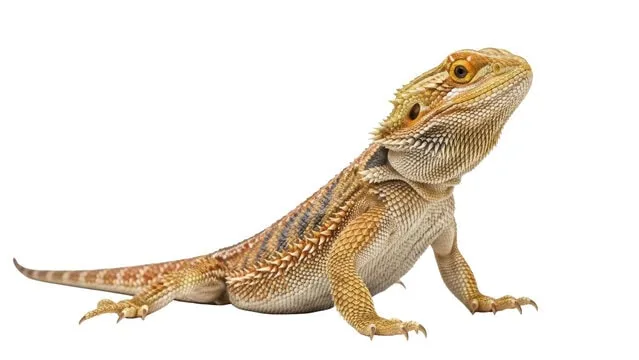
The bearded dragon originates from the arid parts of Australia. Thanks to easy care, a calm nature and interesting behaviour, it is one of the most widespread species in the hobby. It is ideal not only for experienced keepers but also for beginners, especially families with younger children who want frequent interaction with their pet.
Quick facts
Origin
Australia (arid regions)
Size
45–60 cm
Activity
diurnal
Enclosure
min. 100×50×50 cm for an adult
Temperature
basking 35–40 °C · cool side 27–30 °C
UV lamp
required, 8.0–10.0 index
01
Appearance
Like all agamids, they have a large, strong triangular head with the characteristic “beard”. The stocky, massive, flattened body is covered in soft spines, more pronounced along the edge of the belly. They are mostly light brown-beige, with a characteristic pattern on the back that varies by variety (morph). They grow to 45–60 cm (depending on sex, genetics and conditions), which should be kept in mind when providing an enclosure of adequate size.
02
Choosing and buying
When you decide to buy a bearded dragon, there are several things to pay attention to. One of the first is to ask around, so you find a breeder who is reliable and has a good reputation. When buying, on the spot, choose an animal that is active, holds its head up and has its eyes wide open. In older animals, body condition can be judged by the tone of the hind leg muscles and the base of the tail, which should be strong and thick.
Any defect, such as lumps on the body or crooked limbs, may mean the animal has had a fracture or a metabolic disorder (vitamin and mineral deficiency). Also check that all limbs are complete, as it is not unusual for a toe or the tip of the tail to be missing when several dragons are kept in the same enclosure.
03
Behaviour
Bearded dragons are diurnal lizards. They spend most of their time basking under the spot lamp, although they can be very active. There is a whole range of gestures and signals that bearded dragons use to communicate with other animals and their surroundings. When asserting dominance or defending themselves, males flatten the body, darken and puff up the beard while bobbing the head up and down. Females typically (though not always) show submission in these situations (during mating): they lower themselves to the ground, nod the head slowly and make characteristic circles with a front leg, like waving. Juveniles use this gesture much more often when communicating with each other.
04
Sexing
Sexing is relatively easy in sexually mature animals. There are minor differences in appearance between males and females — males are generally larger, have more prominent pre-anal pores and get the characteristic black beard in the breeding season. A more reliable way to determine sex is by the bulges at the base of the tail, just above the vent. A male will have two separate bulges with a depression in the middle of the tail. A female has a single bulge in the middle of the tail, which can sometimes be flush with the tail. To sex a dragon this way, place it on your palm with its head towards your fingers and gently lift the tail to a right angle.
05
Enclosure and conditions
Young dragons should be kept in an interim enclosure of suitable size to avoid stress from too much or too little space. The minimum enclosure for an adult is a 100×50 cm footprint with a height of about 50 cm. As for furnishing, a couple of large rocks and a sturdy branch to serve as a basking and hiding spot are enough. Anything light and unstable in the enclosure will certainly be knocked over, dug up or chewed (eaten), so choose plants carefully — it is best to skip plants altogether. Sand (not quartz), washed gravel, coir, carpet or paper towels can be used as substrate. Ventilation openings covered with stainless mesh should be placed on the sides of the enclosure as well as in the lid.
Since these are diurnal lizards, UV light must be provided by mounting a UV lamp above the ventilation opening in the lid (UV rays do not pass through glass). The UV lamp should be 8.0 or 10.0 (UV index). Additional light and heat should come from a spot lamp (60–100 W) under which the dragon will spend most of the day. The lamp is positioned so the lizard cannot come into direct contact with it (at least 25 cm away), to avoid burns and injuries. The basking spot temperature should be around 35 °C for adults and around 40 °C for juveniles. To let them regulate their body temperature there must be a temperature gradient, so the cooler part of the enclosure should be 27–30 °C. Night temperature can be about 10 °C lower, and is regulated by switching on a heat mat under one third of the enclosure or a ceramic lamp. Be careful with the mat, as it can overheat, which can seriously endanger the lizard’s health and life.
06
Food and water
Bearded dragons have a big appetite, but should not be fed as much as they can eat. As a guide, adults eat 5–15 insects a day, depending on insect size, season etc., while hatchlings and juveniles eat 30 or more appropriately sized insects (no larger than the space between the eyes), split into several daily meals. Every day they should get carrot, apple, lettuce (in limited amounts) and freshly picked dandelion. Supplements are one of the important factors in the diet. While young, calcium should be added to every other meal, and twice a week a vitamin supplement is used instead of calcium. For fully grown dragons, calcium and the vitamin supplement are each given twice a week or less, unless it is a gravid female or a sick animal.
Water in the enclosure should always be clean and available. The dish should be heavy and wide, so the dragon can cool off in it when needed. Young dragons sometimes take a while to learn to drink from a dish; you can get them used to water by placing their two front feet in the bowl. If that does not work, dropping live insects into the water usually does the job. In the colder winter months dragons may enter a state of winter semi-dormancy — brumation. This period is marked by generally reduced activity and refusal of food for several months. It is then important to provide clean water and offer an insect now and then. As soon as brumation passes, be ready to step up feeding so your pet gets back into full condition and regains weight.
The advice given in this text is the result of many years of experience combined with literature and should not be taken as the definitive and only way of keeping the species. To get a fuller picture and give your pet a long and healthy life, we advise you to consult several sources. If you have any further questions, you can contact us by e-mail: petreptilez@yahoo.com
Interested?
Contact us for more information about this pet, availability and care advice.